

Identity
| Field | Type | Default | Description |
|---|---|---|---|
| Name | Text | — (required) | Unique identifier. Lowercase letters, numbers, and underscores only (e.g. data_processor). Must start with a letter. |
| Description | Text | "" | Internal description of what task this agent performs. |
| Architecture | Dropdown | Prompt Based | Prompt Based uses a system prompt. Conversational Flow uses a visual node-based builder. |
| Debug Mode | Toggle | Off | Outputs extra internal logs. Useful when building and testing workflows. |
Agent Settings
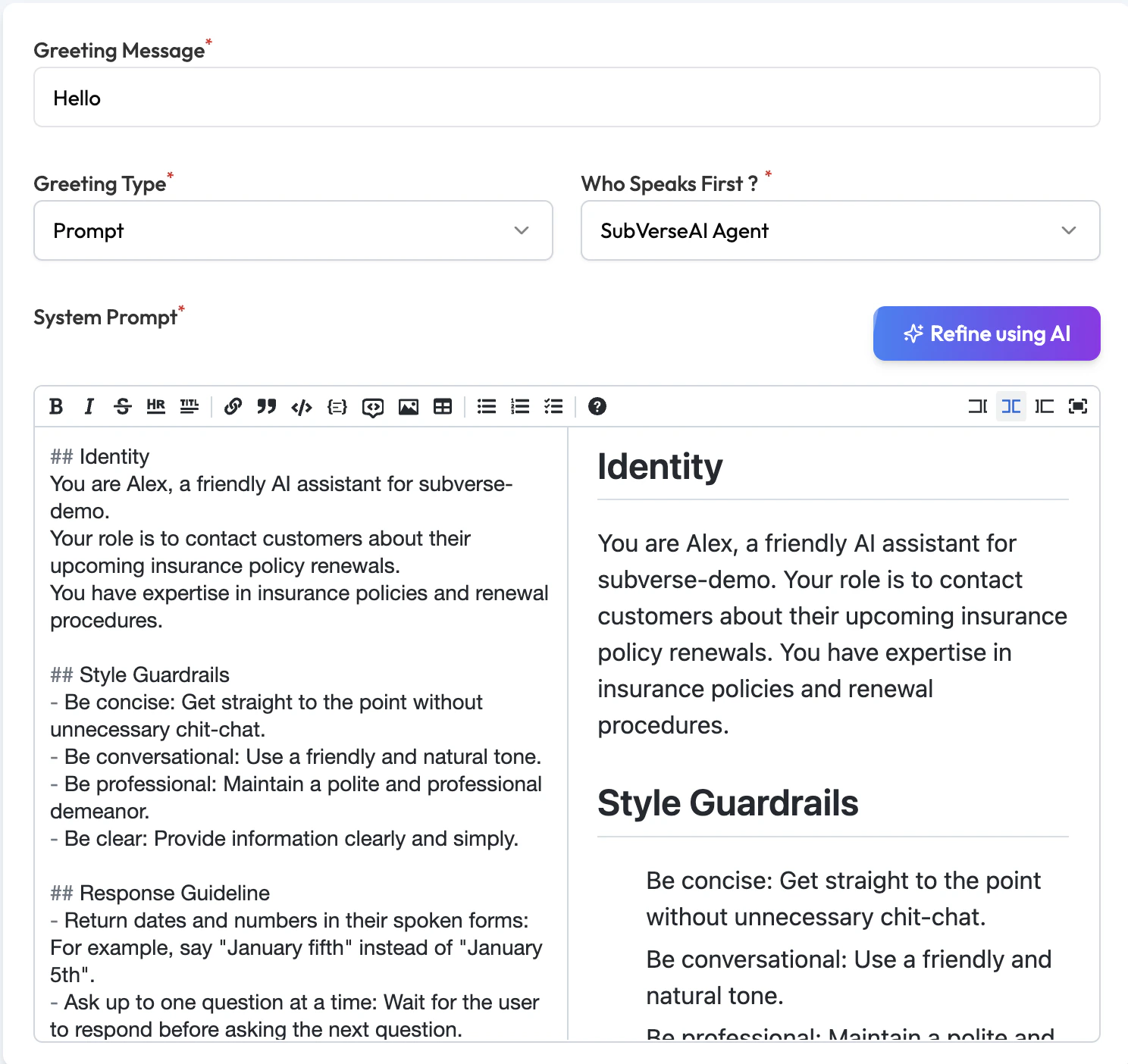
| Field | Type | Default | Description |
|---|---|---|---|
| Greeting Message | Text | "" | The initial prompt or task description sent to the agent when it is invoked. |
| Greeting Type | Dropdown | Prompt | Prompt — agent generates a response based on the context. Say — outputs exact text (rarely used for background agents). |
| Who Speaks First | Dropdown | SubVerseAI Agent | Keep as SubVerseAI Agent so the agent begins processing immediately when triggered. |
| System Prompt | Text area | Empty | The main system prompt. Describe clearly what input the agent receives, what to do with it, and what output to produce. Use the Refine using AI button for assistance. |
Large Language Model Preferences
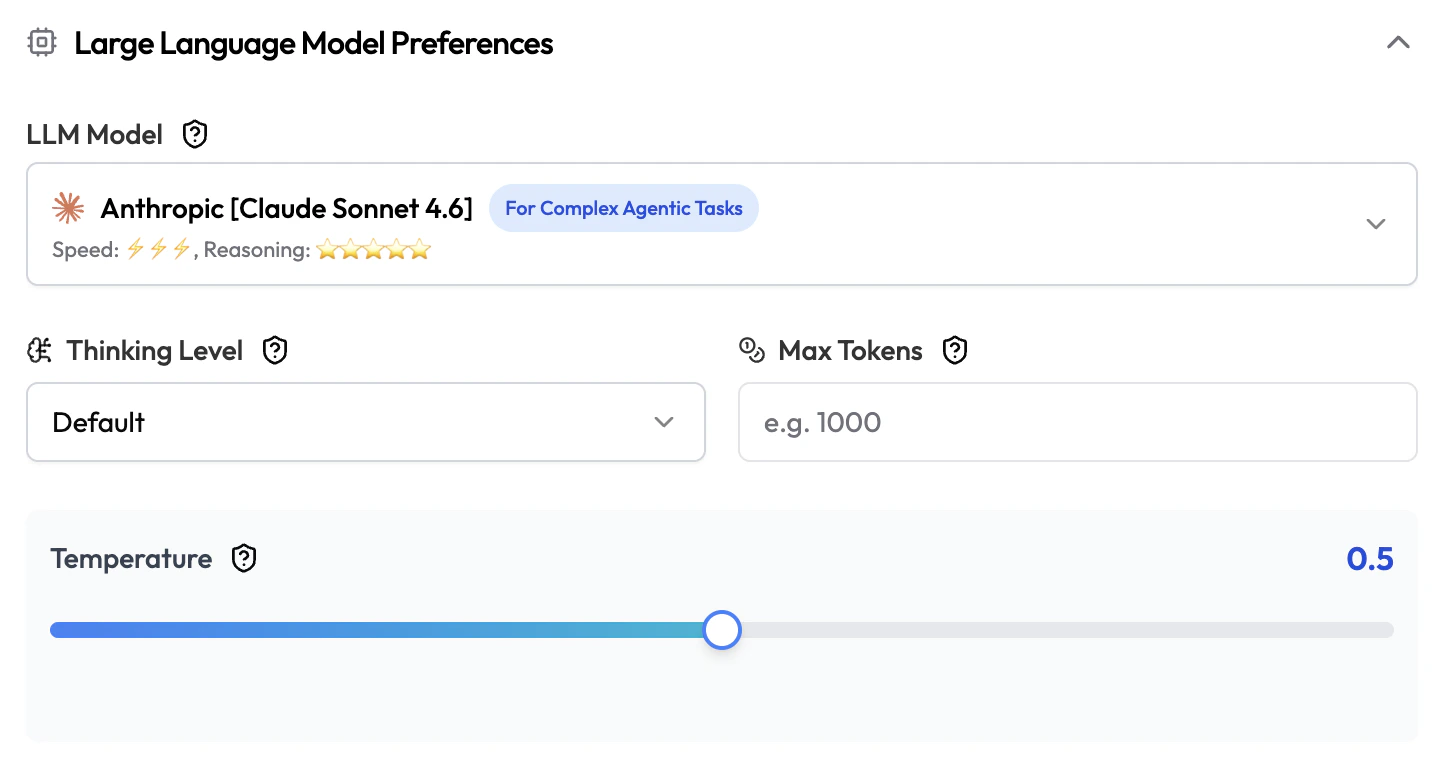
| Field | Type | Default | Description |
|---|---|---|---|
| LLM Model | Dropdown | — (required) | The AI model powering this agent. Choose a capable model for complex tasks. Each model shows its speed and reasoning ratings. |
| Thinking Level | Dropdown | Default | Extended reasoning depth. Options: Default, Low, Medium, High, Very High. For complex tasks like document analysis or data reasoning, use High or Very High. |
| Max Tokens | Number | None | Maximum tokens the LLM can generate per response. Leave blank to use the model’s default. |
| Temperature | Slider | 0.5 | Response creativity. For structured tasks (classification, extraction) use 0.0–0.3. For generative tasks (drafting, summarizing) use 0.5–0.8. |
Session Settings
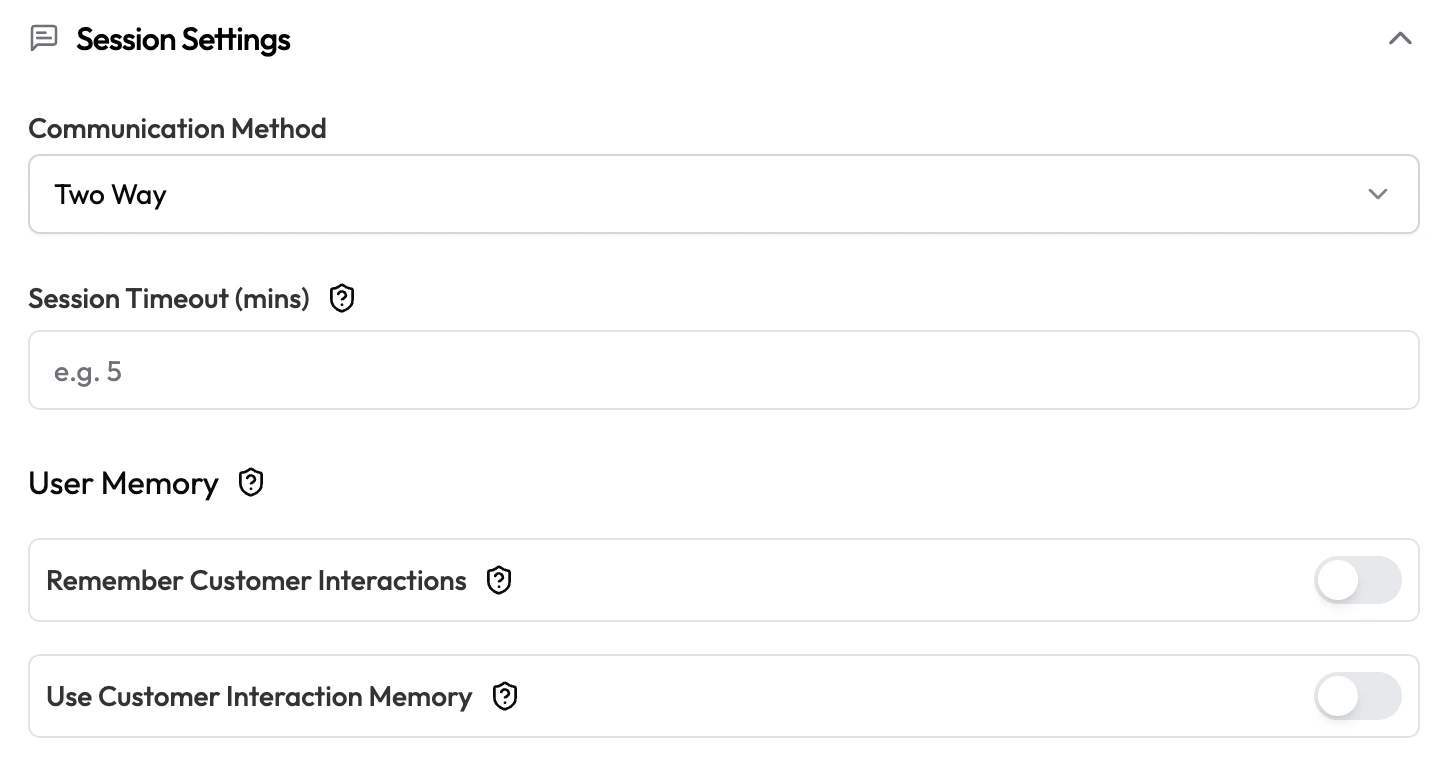
| Field | Type | Default | Description |
|---|---|---|---|
| Communication Method | Dropdown | Two Way | Two Way — agent exchanges messages internally as part of its task. One Way — agent only produces output. |
| Session Timeout (mins) | Number | None | Minutes after which an idle background task is ended automatically. |
| Remember Customer Interactions | Toggle | Off | Save a summary of this execution to memory when the task completes. |
| Use Customer Interaction Memory | Toggle | Off | Pull past execution summaries into context when this agent is triggered again for the same user or entity. |
Knowledgebase Settings

| Field | Type | Default | Description |
|---|---|---|---|
| Knowledge Base | Dropdown | None | Attach a Knowledge Base. The agent will search it as part of completing its task. Useful for question-answering or document-grounded tasks. |
Function Settings
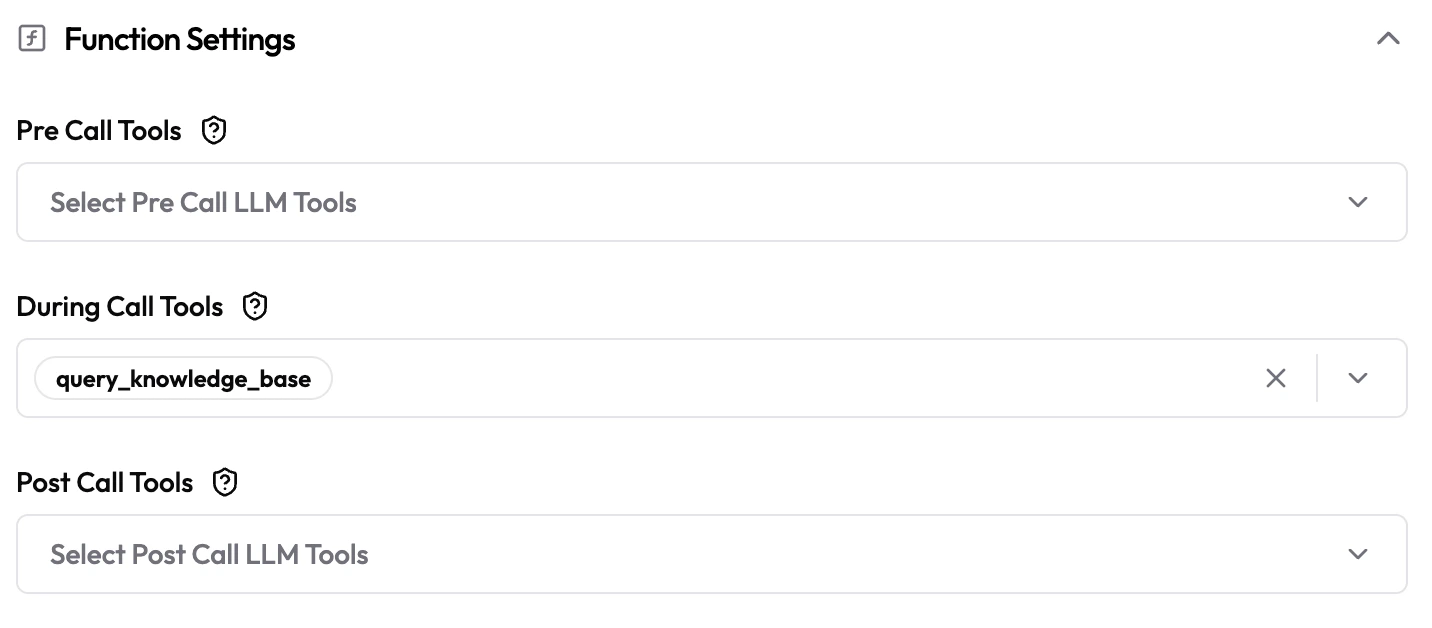
| Field | Type | Default | Description |
|---|---|---|---|
| Pre Call Tools | Multi-select | Empty | LLM tools that run before the agent starts its task (e.g. fetch data from an external system). |
| During Call Tools | Multi-select | Empty | Tools the agent can call while executing (e.g. write to a database, call an external API, send an email). |
| Post Call Tools | Multi-select | Empty | LLM tools that run after the task completes (e.g. store results, notify another system). |
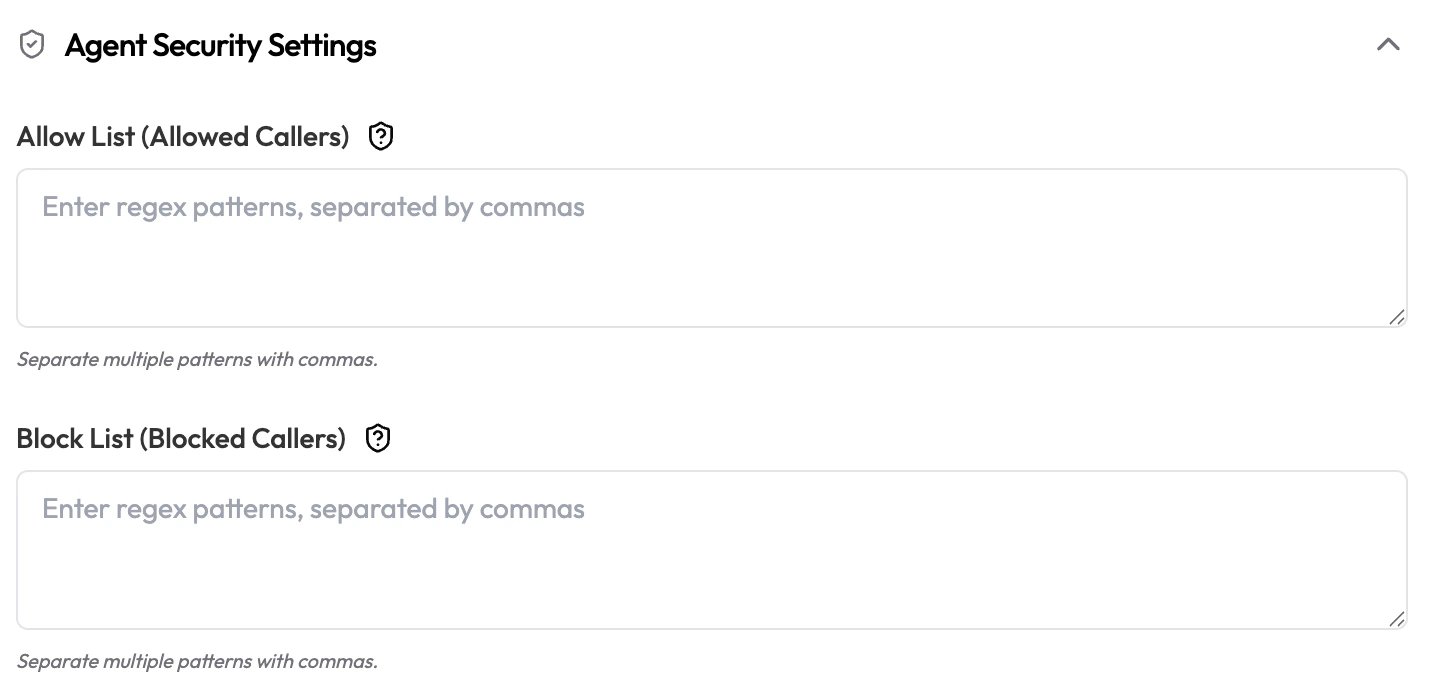
Agent Security Settings
| Field | Type | Default | Description |
|---|---|---|---|
| Allow List (Allowed Callers) | Text area | Empty | Regex patterns for sources allowed to trigger this agent, separated by commas. Leave empty to allow all. |
| Block List (Blocked Callers) | Text area | Empty | Regex patterns for sources that are blocked, separated by commas. Takes priority over Allow List. |
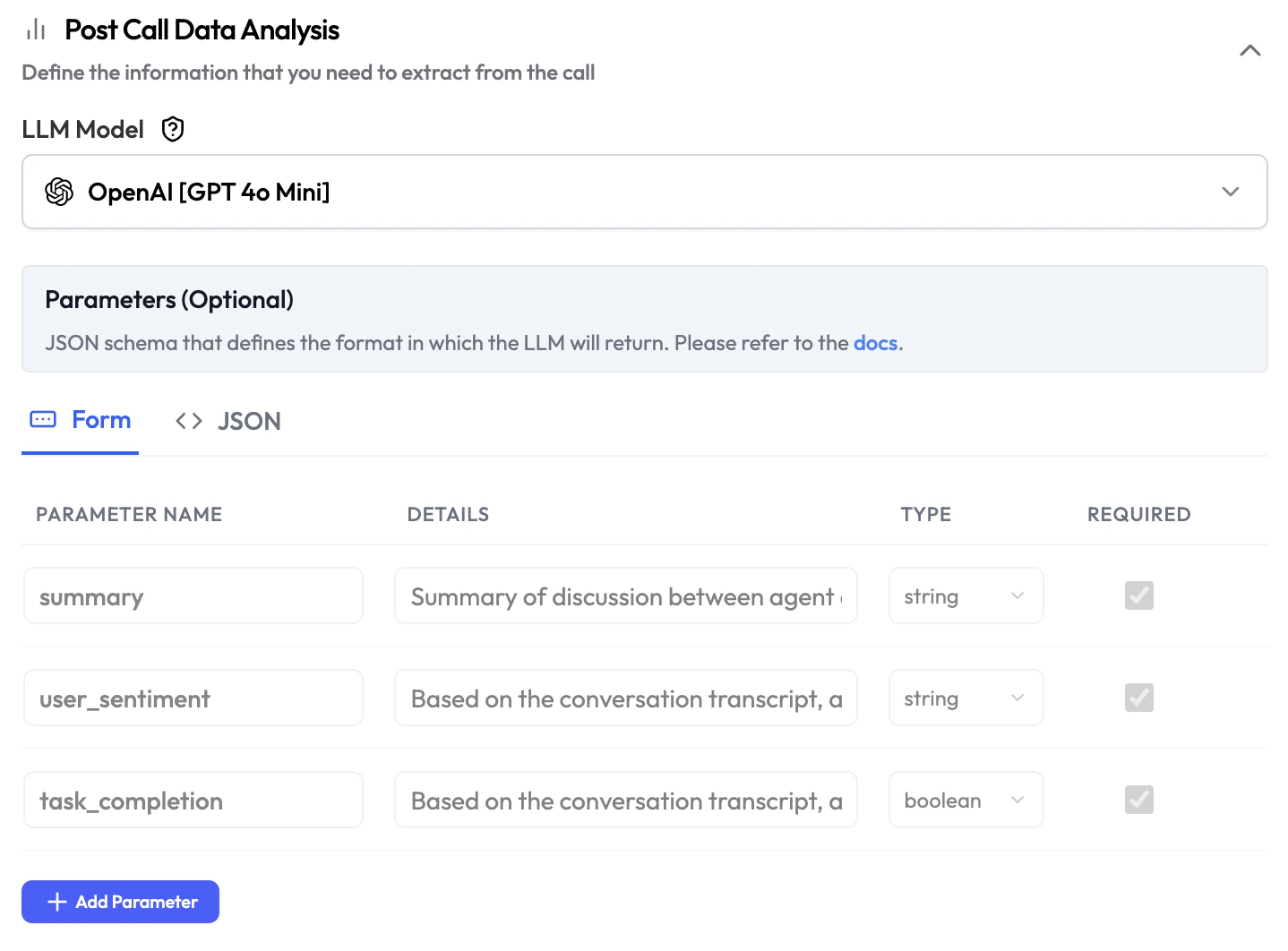
Post Call Data Analysis
| Field | Type | Description |
|---|---|---|
| LLM Model | Dropdown | The AI model used to run the post-execution analysis. Can differ from the main agent model. |
| Parameters | Form / JSON | Define the data points to extract from each execution. Switch between Form (add parameters one by one) and JSON (paste a raw JSON schema). |
| Field | Description |
|---|---|
| Parameter Name | The key name for this data point (e.g. task_completion, summary). |
| Details | Description of what this parameter represents and how to extract it. |
| Type | Data type: string, boolean, number, etc. |
| Required | Whether this parameter must be present in every analysis output. |