Respond to Webhook
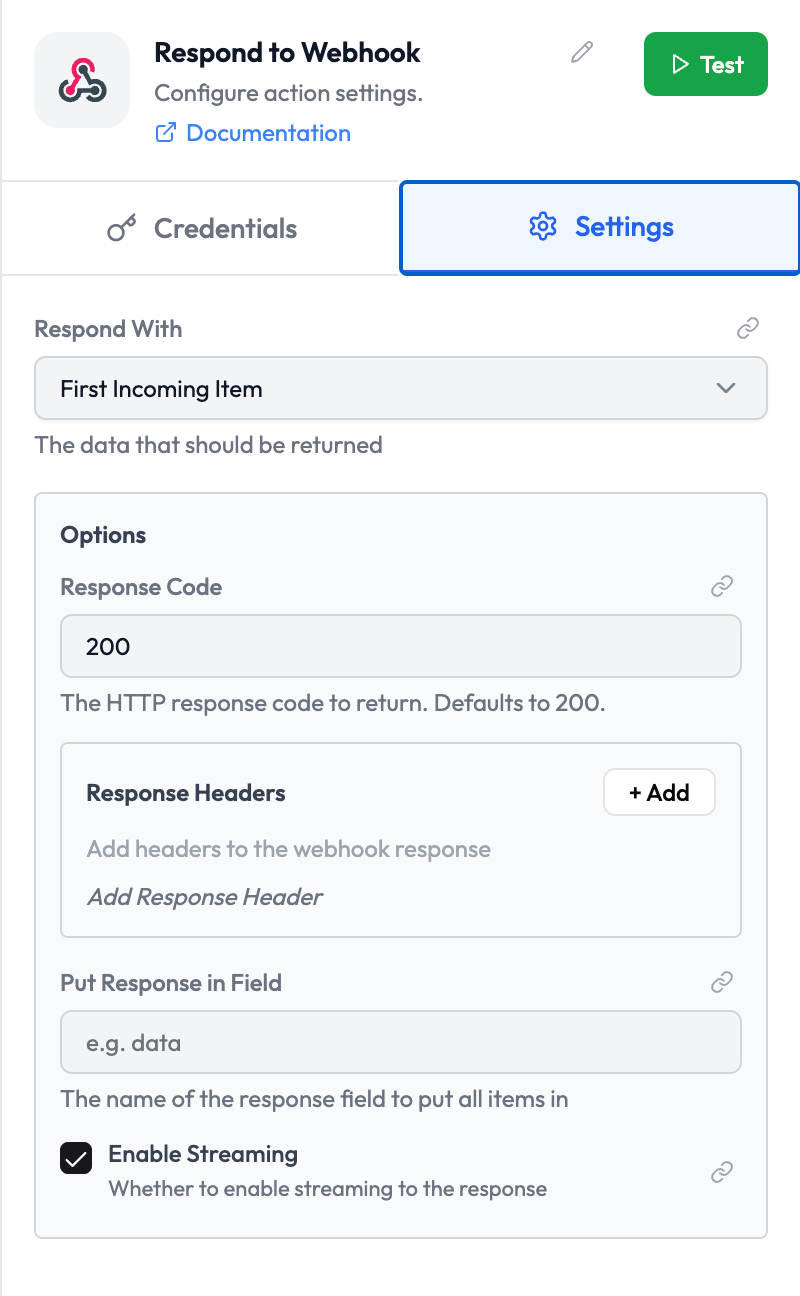
The Respond to Webhook node sends a custom HTTP response back to the caller of a Webhook Trigger. It is used when you need full control over the HTTP response — custom status codes, headers, or body content.
Use Cases
- Return a custom JSON response to an API caller after processing
- Respond with a specific HTTP status code (e.g.
201 Created,400 Bad Request) - Set custom response headers (e.g.
Content-Type,X-Request-ID) - Build synchronous webhook endpoints that return processed data
Prerequisites
The orchestration’s Webhook Trigger must have Response Mode set toUsing Respond to Webhook Node. If the response mode is set to Immediately or When Last Node Finishes, this node has no effect.
Node Reference
Parameters
| Parameter | Type | Required | Description |
|---|---|---|---|
| Respond With | Select | Yes | The format of the response body (see below) |
| Response Body | String / JSON | Conditional | The body to return (required for JSON, Text, Binary) |
| Response Code | Number | No | HTTP status code (default: 200) |
| Response Headers | Key-Value | No | Additional headers to include in the response |
Respond With Options
| Option | Description |
|---|---|
All Incoming Items | Return the full output of all upstream nodes as JSON |
First Incoming Item | Return only the first item from the upstream output |
JSON | Return a custom JSON body |
Text | Return a plain text body |
Binary | Return a binary file (e.g. an image or PDF) |
No Data | Return an empty response with just a status code |
Example: Return a Custom JSON Response
Configuration:| Field | Value |
|---|---|
| Respond With | JSON |
| Response Code | 200 |
| Response Body | { "status": "success", "orderId": "{{ airtable.id }}" } |
Example: Return a 400 Error
| Field | Value |
|---|---|
| Respond With | JSON |
| Response Code | 400 |
| Response Body | { "error": "Invalid request", "message": "{{ conditions.reason }}" } |
Related Nodes
- Webhook Trigger — The trigger node this node responds to
- Conditions — Branch before responding based on orchestration logic